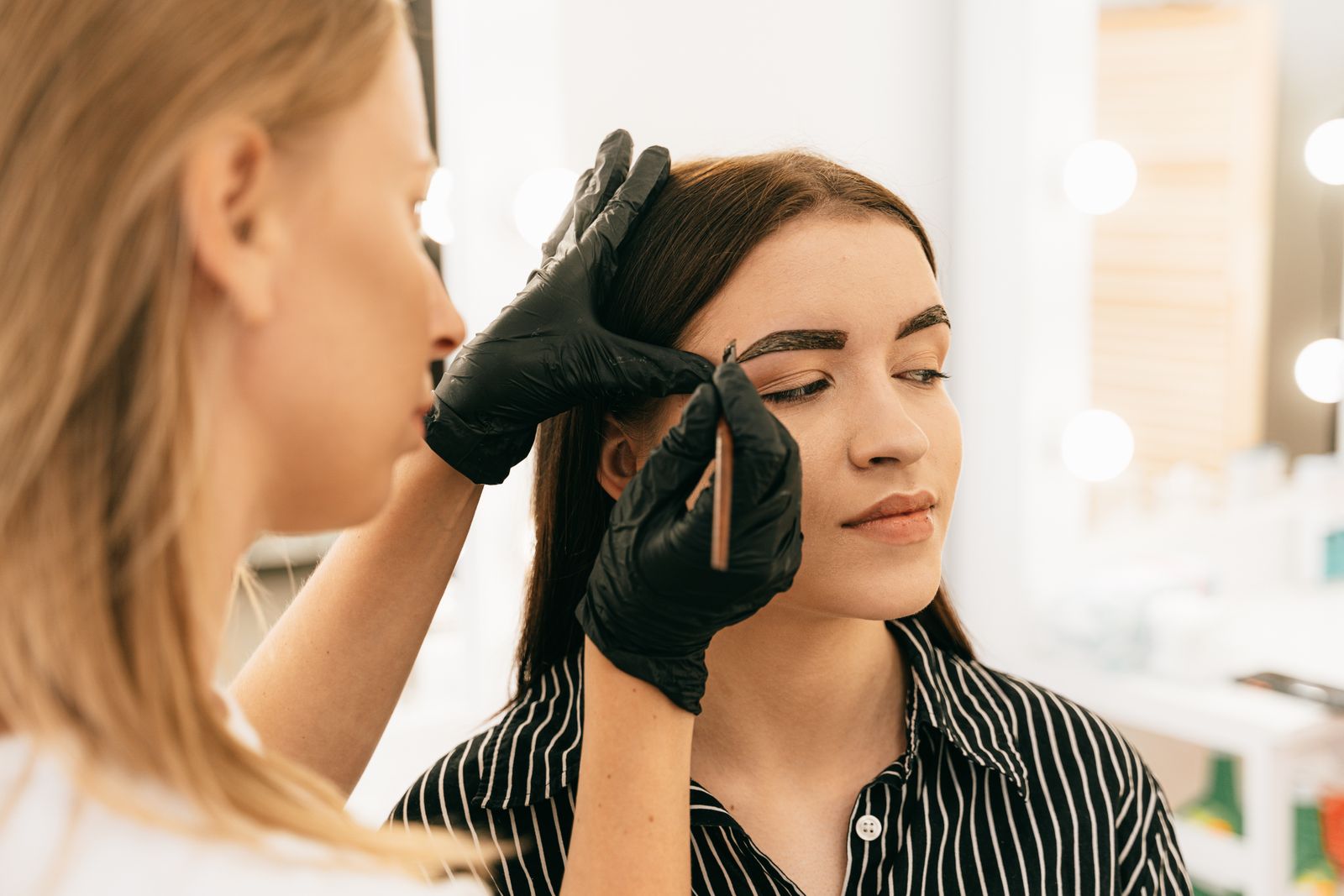
If you have semi-permanent brows, eyeliner or lip blush, tell the clinic before any pigment laser, laser toning or laser hair removal near those areas. Cosmetic tattoo ink absorbs laser light the same way natural pigment does. A laser aimed at nearby spots or hair can lighten the tattoo unevenly, shift its colour (some brown and nude inks turn grey, black or orange) or heat the skin more than intended. In practice, Seoul clinics deal with it simply: the practitioner leaves a margin around the tattoo, covers it, or turns the settings down near it. They can only do that if they know it’s there. Fresh tattoos need extra care, and old faded ones still count.
Why does a laser react to cosmetic tattoo ink at all?

Pigment lasers and laser hair removal work by sending light into the skin that’s absorbed by colour. Tattoo pigment is colour sitting in the skin, so the laser treats it as a target too.
- Pigment lasers and toning (pico lasers, Q-switched Nd:YAG “toning” and similar) are built to break up small pigment particles. That’s how they lighten sun spots and melasma, and it’s also how tattoos are removed on purpose. When the beam passes over tattooed brows, it can start “removing” them, often patchily.
- Laser hair removal is tuned to melanin in the hair follicle. Dark tattoo ink also soaks up that energy, so a pass over a brow tattoo or lip liner can heat the skin there more than the surrounding skin. That raises the chance of redness, blistering or a small burn.
- Gentler “genesis”-type toning that warms the skin works at lower energy, but it’s still light hitting pigment, so it still deserves a mention.
Treatments that don’t target colour, such as microfocused ultrasound (Ultherapy-type lifting) or radiofrequency (Thermage-type), act differently. They aren’t drawn to ink the way pigment lasers are. Still, tell the clinic about tattoos near the treatment zone. They’ll decide what matters for that device.
What can actually happen to brows, eyeliner or lip blush?
The most common surprise is a colour change, not damage. Many cosmetic tattoo inks contain iron oxides and white or flesh-tone pigments (such as titanium dioxide). Under some lasers these can darken to grey or black, or a brown brow can turn reddish or orange as some pigments break down faster than others. This is called paradoxical darkening, and it can be stubborn to correct.
Other possible outcomes:
- Uneven fading. One section of the brow lightens and the rest doesn’t, so the shape looks patchy.
- Shape loss at the edges. A pass along the hairline or brow tail softens the crisp edge an artist drew.
- Heat-related irritation. Mainly with hair removal over dark ink: redness, swelling or blistering confined to the tattoo.
- Nothing visible. Low-energy toning that stays clear of the tattoo often leaves it untouched. That’s the usual result when the clinic knows and works around it.
How a particular tattoo will respond depends on the ink, its depth, its age and the device. Nobody can promise in advance exactly what will happen, so the safe default is to keep the laser off the tattoo unless you’re deliberately trying to fade it.
How do Seoul clinics usually work around tattooed areas?
Once the tattoo is noted, clinics typically do one or more of the following:
- Leave a margin. The practitioner stops a few millimetres short of the brow, lash line or lip border, so the area right next to the tattoo goes untreated.
- Cover the tattoo. A white pencil, a small shield or a damp gauze pad is placed over the ink during toning. White reflects much of the light instead of absorbing it.
- Adjust settings or the tip. Lower energy or a smaller spot near the tattoo, with the full settings used elsewhere on the face.
- Skip the zone. For laser hair removal between the brows or on the upper lip next to lip liner, the tattooed edge may simply be left out.
- Use eye protection. For anything near eyeliner, you’ll wear eye shields or goggles. Eyelid-margin tattoos usually stay outside the treated area entirely. (If you wear contacts, see our note on lenses and eye shields.)
What this means for you: your spots or facial hair right next to a tattoo may get a lighter treatment than the rest of your face. That’s a deliberate trade-off, not an oversight.
What if your tattoo is fresh — how long should you wait?
A cosmetic tattoo that’s still healing is broken, inflamed skin. A common guideline is to wait until it has fully healed, often four to six weeks after the session or touch-up, before lasers, peels or hair removal near it. Some clinics ask for longer, and your tattoo artist may have their own rule.
Things to plan around:
- Don’t stack them in one trip. If you’re getting brows done in Seoul, laser toning on the same visit is usually better pushed to a later trip. If you must do both, have the laser first and the tattoo afterwards, and check with both providers. Many tattoo artists also ask you to wait after laser or peels.
- Numbing cream and fresh ink. Topical numbing over a healing tattoo isn’t something to improvise. Let the clinic decide.
- Scabbing or flaking brows. Mention it even if the session was a while ago. Slow healing changes the plan.
If you had a touch-up within the last few weeks, say the date. “Brows touched up on 2 November” is far more useful to a clinic than “fairly recently”.
Do old, faded tattoos still matter?
Yes. Faded ink is still ink, and older cosmetic tattoos are the most likely to contain the iron-oxide or flesh-tone pigments that can darken. Some people also forget about tattoos they no longer notice: a lip liner from years ago, a faint lash-line tint, a camouflage tattoo over a scar, or scalp micropigmentation near the hairline.
Some people are actually hoping the laser will fade an old brow tattoo they no longer like. That’s a reasonable goal, but it’s a different treatment. Deliberate tattoo removal uses different settings, usually takes several sessions spaced weeks apart, and may darken before it lightens. Raise it as its own question at consultation instead of hoping toning will take care of it along the way.
What exactly should you tell the clinic?
Put it on your intake form and say it again to the person doing the treatment. A short note covers it:
- Where: brows, upper/lower eyeliner, lip blush or lip liner, hairline, a scar camouflage
- When: the date of the last session or touch-up
- What kind (if you know it): microblading, powder/ombré brows, machine tattoo, and the ink colour
- Any past reactions: colour change after a laser, swelling, slow healing
- What you want: “keep my brows exactly as they are”, or “I wouldn’t mind them fading”
If you already keep a written list of allergies and past reactions, add this to it (here’s how to write one for reception). Lip blush, in particular, is worth mentioning next to any history of cold sores, since lip-area work involves both (why clinics ask about cold sores).
What about botox, filler or skin boosters near tattooed brows?
Injections don’t react with ink, but they can change how a tattoo sits. Forehead or brow botox can slightly lift or lower the brows, and a tattooed brow that looked balanced may then look higher or flatter on one side. A brief “my brows are tattooed — please keep their position in mind” helps the doctor plan the dose and placement. Needle-based treatments such as microneedling or skin boosters close to fresh ink follow the same healing rule as lasers: wait until the tattoo has settled.
What does this cost in Seoul, and does a tattoo change the price?
Approximately, laser toning sessions in Seoul often run from about KRW 30,000 to KRW 150,000 (around USD 20–110) depending on the device and the clinic. Small-area facial hair removal (upper lip, between the brows) is often in the KRW 10,000–50,000 range (roughly USD 7–35) per area. These are rough market figures, not quotes. Working around a tattoo usually doesn’t change the price. It changes where and how the laser is used.
Getting toning or facial hair removal around a tattoo at MIO Clinic
Seoul Skin Notes is run by MIO Clinic.
If you have tattooed brows, liner or lip blush and want pigment toning or facial hair removal planned around them, MIO Clinic in Gangnam is one option. MIO’s published menu (prices as published at the time of writing, excluding VAT) includes:
- PicoSure Toning + Mask: KRW 39,000 (about USD 28) per session. No numbing listed, and it can be scheduled on any day of a trip.
- PicoSure Focus Toning: KRW 59,000 (about USD 42). Numbing is used, and MIO advises it for the last day of a trip.
- Genesis Toning: KRW 69,000 (about USD 49). No numbing, any day.
- Women’s hair removal between the eyebrows or on the upper lip: KRW 10,000 (about USD 7) per area. Brief stinging, any day. Both areas sit right next to brow tattoos and lip liner, so mention them before booking.
Pigment and laser work is part of the published focus of Kim Doyoung (skin boosters, lasers, pigmentation) and Lee Seungwook (acne, scars, pores, lasers). Both are experienced, and both consult in English. Choosing a specific doctor adds KRW 100,000 (about USD 71). Otherwise the doctor is assigned at booking.
MIO assesses the face with detailed clinical photography and AI-assisted facial analysis before planning treatment. The doctor then decides where the laser goes and where it stops. That record makes it easier to mark exactly where your tattoo ends and the treated skin begins. Final cost depends on your assessment and can’t be quoted in advance.
FAQ
Can I get laser toning if I have microbladed or powder brows? Usually yes. The clinic leaves a margin around the brows or covers them, and treats the rest of the face normally. Tell them before the laser starts.
Will laser hair removal between my eyebrows affect my brow tattoo? It can if the beam passes over the ink, because dark tattoo pigment absorbs the energy and can heat up or change colour. Clinics usually treat only the untattooed skin in between.
How long after a brow or lip blush touch-up should I wait before a laser? A common guideline is until it has fully healed, often four to six weeks, and some clinics ask for longer. Give the clinic the exact date of your last session.
Can laser toning remove an old brow tattoo I don’t like? Toning isn’t designed for that. Deliberate tattoo removal uses different settings and usually several sessions, and some inks darken first. Ask about it as a separate treatment.
Is HIFU or radiofrequency lifting safe over cosmetic tattoos? These devices don’t target pigment the way lasers do, so ink is less of a concern. Still mention any tattoos near the treatment zone so the clinic can decide.
My eyeliner tattoo is very faint. Do I still need to mention it? Yes. Faded ink is still pigment, and older inks are the most likely to change colour under a laser. It takes one sentence on the intake form.
Book at MIO Clinic, Gangnam
Seoul Skin Notes is the official journal of MIO Clinic, a skin & aesthetic clinic in Gangnam, Seoul. The MIO team handles consultations and bookings in English over WhatsApp — tell them what you are considering and they will walk you through your options.
MIO Clinic
2-3F, FINE TOWER, 372 Gangnam-daero, Gangnam-gu, Seoul
Gangnam Station, Exit 4 — 3-minute walk
Hours: Mon & Fri 10:00–21:00 · Tue–Thu & Sat 10:00–19:00 · Sun 10:00–19:00
Web:mioclinic.kr/en · Instagram:@mioclinic_global · Email:en-official@mioclinic.kr · Google Maps