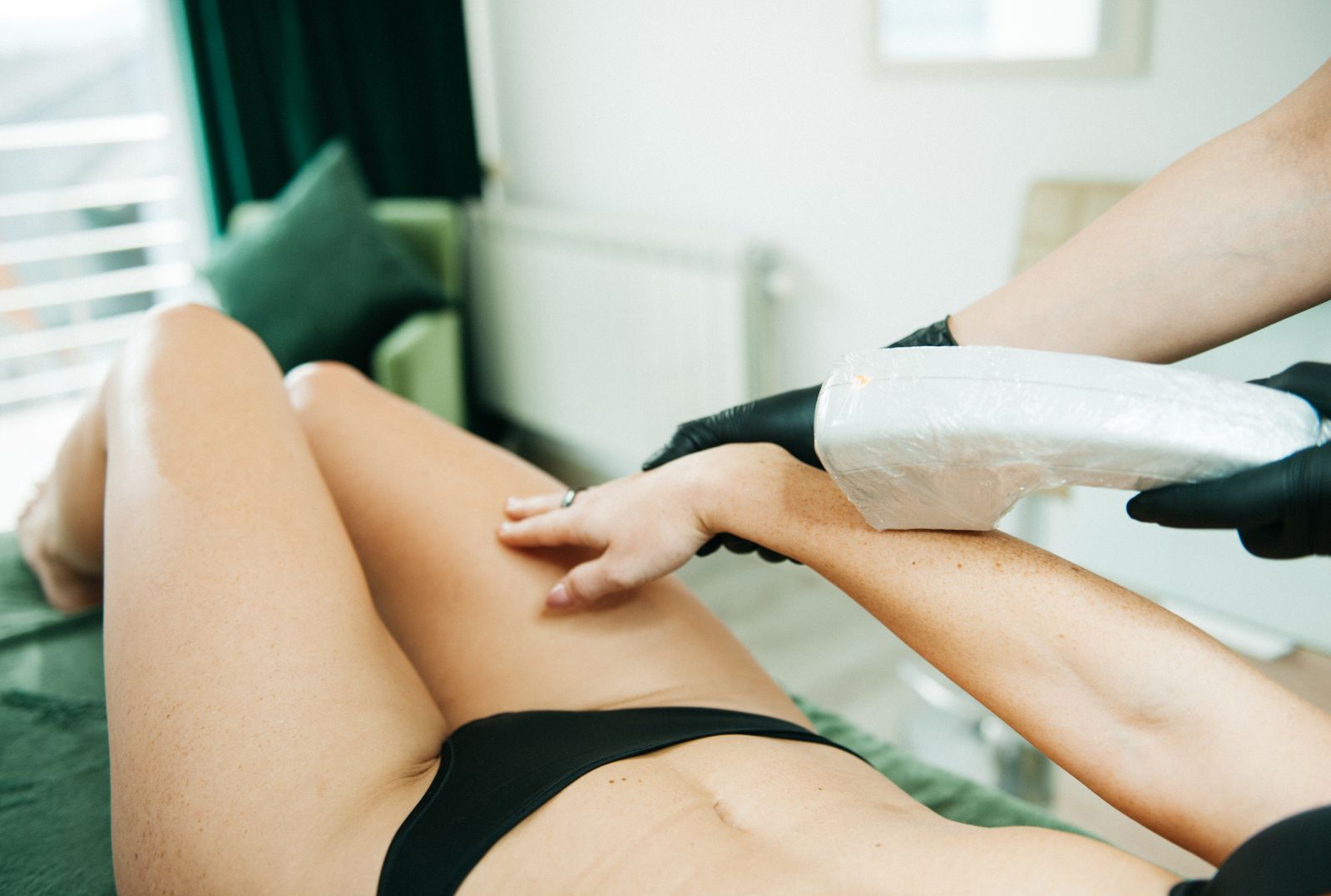
If you have deeper skin, the honest answer is that laser hair removal can work well for you — but the wavelength, the pulse settings, and the cooling all have to change, and a clinic that treats every skin tone with the same setting is the thing to walk away from. Hair removal lasers work by heating pigment in the hair follicle. Your skin contains pigment too. The more melanin in your skin, the harder it is for the device to tell the target from the surroundings, and the more the settings have to shift toward longer wavelengths, longer pulses, lower energy, and stronger cooling. That’s the whole logic of device selection, and everything below follows from it.
Why does skin tone change which laser is used at all?

Because the laser can only see pigment, not hair.
The beam is absorbed by melanin. Ideally it’s absorbed by the melanin packed in the hair shaft and follicle, which heats up and damages the structures that regrow the hair. If your skin also holds a lot of melanin, some of that energy gets absorbed in the epidermis on the way down — which is what causes burns, blistering, and post-inflammatory hyperpigmentation (the dark marks left behind after skin is injured).
Three settings are adjusted to manage this:
- Wavelength. Longer wavelengths penetrate deeper and are absorbed less by surface pigment, so they pass through more safely on deeper skin.
- Pulse duration. Longer, slower pulses let the thin epidermis shed heat between deliveries while the thicker hair follicle still accumulates it.
- Fluence (energy) and cooling. Lower energy is safer but less effective per session; contact cooling, cryogen spray, or chilled air protects the skin surface so usable energy can still be delivered.
This is why the same person can get an excellent result at one clinic and a burn at another with the “same” treatment name. The name on the menu tells you very little. The settings are the treatment.
Which device type suits which skin tone?

Clinics generally sort skin using the Fitzpatrick scale (I, very fair and always burns, through VI, deeply pigmented and rarely burns). Broad, widely accepted matching looks like this:
- Alexandrite (755 nm) — highly effective on lighter skin (roughly Fitzpatrick I–III) with dark, coarse hair. It’s strongly absorbed by melanin, which is exactly why it becomes riskier as skin gets deeper.
- Diode (around 800–810 nm) — a middle ground, usable across a wider range including medium and some deeper tones, especially in newer “in-motion” formats that deliver many low-energy passes with continuous cooling instead of a few high-energy shots.
- Nd:YAG (1064 nm) — the long wavelength. Least absorbed by epidermal melanin, and the standard safe choice for deeper skin (roughly Fitzpatrick IV–VI) and for anyone who is currently tanned. It tends to be more uncomfortable per pulse and can need more sessions, because the same wavelength that spares your skin is also less efficient at grabbing the hair.
- IPL (intense pulsed light) — not a laser. It’s a broad band of light, which makes it less selective. It has real uses, but it is a poor and riskier choice for deeper skin tones, and a clinic offering only IPL for Fitzpatrick V–VI is not the right fit.
Many clinics in Seoul, including MIO, work from an assessment first rather than a fixed menu — your tone, your current tan status, your hair colour and thickness, and the body area all feed into which device and which settings get used, and it’s normal for different areas of the same person to be treated with different settings on the same day.
One thing to be clear about: no skin tone is harder to treat because there’s anything wrong with it. Deeper skin simply shares more pigment with the target, so the physics demands a different tool.
What if your hair is light, grey, red, or very fine?
This is the limitation people are least warned about, so here it is plainly: laser hair removal works on pigment, and hair without much pigment does not respond well.
- Grey and white hair — essentially no melanin. Lasers do very little. Any clinic promising clearance on white hair is overpromising.
- Red and blond hair — largely pheomelanin, which absorbs poorly. Results are unpredictable and usually partial at best.
- Fine, soft vellus hair — too little pigment and too small a target. It often responds poorly, and in some cases treating fine hair at the border of a treated area is associated with paradoxical hypertrichosis (hair growing thicker rather than thinner), most often reported on the face, neck, and jawline.
Dark, coarse hair on any skin tone is the ideal target. That combination — not skin tone alone — is the strongest predictor of how well a course will go.
How many sessions, and how far apart?
Hair grows in cycles, and only follicles in the active growth (anagen) phase are vulnerable to the laser. At any moment, only a fraction of the hair in an area is in that phase — which is why one session can never do it. Sessions are spaced to catch different follicles as they cycle in.
Typical planning, with the caveat that individual variation here is large:
- A full initial course is usually in the range of 6–10 sessions. Some people need more, particularly with hormonally driven facial or body hair.
- Face and neck: roughly every 4 weeks. Hair here cycles faster.
- Body (underarms, legs, bikini, back): roughly every 6–8 weeks, sometimes stretching longer as the remaining hair thins out.
- Deeper skin tones often need a few more sessions, because the safe fluence is lower. This is a normal trade-off, not a sign anything is going wrong — it buys a much lower risk of burns and dark marks.
- After the course, most people need occasional maintenance — commonly one or two top-ups a year, more if there’s a hormonal driver like PCOS.
Between sessions, shaving is fine and expected — the laser needs the follicle intact and pigmented under the skin. Waxing, threading, plucking, and epilating are not, because they pull out the very target the laser is aiming at. Most clinics ask you to shave the area within about 24 hours before your appointment.
What do results actually look like after a full course?
Not “hair-free forever.” The honest description is long-term reduction: fewer hairs, finer hairs, slower regrowth, and a visible thinning of density rather than a bare surface.
A realistic timeline:
- After 1–2 sessions: treated hairs shed over roughly 1–3 weeks. This looks like regrowth but is the hair working its way out. Density looks similar; you may notice the regrowth is softer.
- After 3–4 sessions: most people see genuine patchy thinning and longer gaps between shaves.
- After a full course: substantial reduction in the treated area, with some persistent fine or lighter hairs that the laser simply cannot see.
- Over the following years: some regrowth is normal, especially with hormonal changes (pregnancy, PCOS, thyroid conditions, some medications).
Results also vary by area. Underarms and bikini tend to respond strongly. Legs and forearms respond well. Faces, necks, and jawlines — often hormonally driven and finer haired — are the least predictable, and it’s fair to expect improvement rather than clearance there.
What are the actual risks, and who shouldn’t have it?
Every hair removal laser session carries some risk, and the risk profile shifts with skin tone.
Common and expected: redness and follicular swelling (small bumps around each follicle) for a few hours to about two days; a sensation like a rubber band snap or a hot pinprick during treatment; mild tenderness afterwards.
Less common: blistering or burns; post-inflammatory hyperpigmentation or hypopigmentation — the main concern on Fitzpatrick IV–VI, and the reason conservative settings and a test patch matter; folliculitis (small pustules around follicles, particularly in hot, humid weather); temporary crusting; paradoxical hair growth at treatment borders.
Poor candidates, or reasons to postpone:
- A fresh tan or a sunburn. A recent tan means more surface melanin than the settings were chosen for. Most clinics ask for roughly 2–4 weeks without meaningful sun exposure or self-tanner before and after a session. If you arrived in Seoul off a beach holiday, say so — it changes the plan. (Related: what actually undoes a tan and new spots.)
- Isotretinoin, recently or currently — clinics differ on the required interval, so this must be declared.
- Photosensitizing medications — some antibiotics, some diuretics, St. John’s wort, certain acne treatments.
- Active infection, cold sores, or open skin in the treatment area.
- Pregnancy — generally deferred as a precaution rather than because harm is established.
- Tattoos and permanent makeup in the treatment field — these must be worked around, not over.
- Light, grey, or red hair, as above — the honest answer may be that this isn’t the right treatment for you.
- A history of keloids or of easy post-inflammatory pigmentation — not an automatic no, but a reason for a genuinely cautious first session.
If your skin reacts easily in general, it’s worth reading how a clinic should adjust the plan for sensitive skin before you book.
What should a first visit actually include?
Hair removal is a medical treatment, and a first visit at a properly run clinic should involve an assessment before any energy is delivered — your skin tone and current tan status, hair colour and coarseness, medical and medication history, previous laser or waxing history, and any past reactions.
For deeper skin tones, a test patch on a small, discreet area is a reasonable thing to ask for — usually reviewed after a few days to a couple of weeks before the full area is treated. It costs you one visit and it is the single most useful safeguard against a bad first session.
Reasonable questions to ask: Which wavelength are you using on me, and why that one for my skin? What are you doing to cool the skin? Will you test patch first? How many sessions do you expect for this area, and what happens if I need more?
On comfort: most people tolerate hair removal lasers without numbing, but topical numbing cream is available in many clinics for sensitive areas and usually needs 30–45 minutes to work — worth asking about when you book rather than on the day. There’s more on how numbing is actually handled in Seoul clinics if you’re anxious about pain.
Aftercare in Seoul’s heat and humidity
Seoul summers are hot and genuinely humid, and that matters more for hair removal aftercare than for most treatments — heat, sweat, and friction on freshly treated follicles are what turn a normal session into folliculitis.
For roughly the first 24–48 hours:
- No jjimjilbang, sauna, hot tubs, or very hot showers. Lukewarm only.
- No gym, running, or anything that makes you sweat heavily. Sweat sitting in open follicles is the main folliculitis trigger.
- No swimming pools or public baths while the skin is reactive.
- Loose, breathable clothing over treated areas — tight synthetic leggings over freshly lasered legs in August is asking for bumps.
- Cool compresses if the area feels hot; a bland, fragrance-free moisturiser is fine.
For the following weeks:
- Daily broad-spectrum sunscreen on any exposed treated area, reapplied. This is not optional on deeper skin — it’s the main defence against post-inflammatory pigmentation, and against arriving at your next session with a tan that forces the settings down.
- No scrubs, retinoids, or acid exfoliants on the area for about a week.
- Don’t pick or scratch the shedding hairs. Let them work out on their own.
- Shave, don’t wax or pluck, for the whole course.
If you see blistering, spreading redness, unusual pain, or dark marks forming, contact the clinic rather than waiting for the next appointment.
What does it cost in Seoul?
Prices vary widely by clinic, area, device, and whether you buy sessions individually or as a course, so treat everything below as an approximate market picture rather than a quote — and note that the final figure depends on your skin, your hair, and how many sessions you actually need, which nobody can responsibly tell you before assessing you.
As a rough guide to single-session pricing in Seoul:
- Small areas (underarms, upper lip, chin): often around 30,000–80,000 KRW (about USD 22–59)
- Bikini or Brazilian: often around 80,000–200,000 KRW (about USD 59–148)
- Lower legs or full arms: often around 100,000–250,000 KRW (about USD 74–185)
- Full legs or a full back: often around 200,000–450,000 KRW (about USD 148–333)
- Full face: often around 100,000–250,000 KRW (about USD 74–185)
Because a real course is 6–10 sessions, the number that matters is the course total, not the per-session price — a small area might come to roughly 250,000–600,000 KRW (about USD 185–445) across a full course, while full legs can run well past 1,500,000 KRW (about USD 1,110). Multi-session packages are standard practice and usually work out lower per session. Conversions here use an approximate rate; check the live rate when you budget.
Two cost realities worth planning around: maintenance sessions after the course are an ongoing expense, not a one-off, and deeper skin tones may need a few extra sessions at safe settings, which should be discussed as part of the plan rather than discovered halfway through.
If you’re only in Seoul for a short trip
This is where honesty helps more than enthusiasm. A full course takes six months to a year because of the mandatory spacing between sessions. You cannot compress it — sessions stacked closer together don’t work, because the follicles simply aren’t in the growth phase yet.
Realistically, on a one- or two-week trip you can complete one session, occasionally two if the trip spans a face-treatment interval. That’s still worth doing if you’re planning repeat visits to Korea, or if you want a test patch and a clear treatment plan you can continue at home. But if a single trip is all you have, a treatment that delivers most of its result in one visit may suit you better — and a good clinic will tell you that rather than sell you a package you can’t finish.
If you do start a course here and continue elsewhere, ask for your treatment record in writing: device wavelength, fluence, pulse duration, spot size, and the number of passes per area. Any competent clinic can continue from that; nobody can safely continue from “I had laser in Korea.”
FAQ
Can I get laser hair removal if I have dark skin? Yes, with the right device. The standard safe choice for deeper skin (roughly Fitzpatrick IV–VI) is a long-wavelength Nd:YAG at 1064 nm, often with longer pulse durations, lower fluence, and strong cooling. Ask specifically which wavelength will be used on you, and ask for a test patch first. Avoid clinics that offer only IPL for deeper tones.
How many sessions will I actually need? Most people need 6–10 sessions for an initial course, spaced about 4 weeks apart on the face and 6–8 weeks apart on the body, followed by occasional maintenance — commonly once or twice a year. Deeper skin tones sometimes need a few extra sessions because safe settings are more conservative. Individual variation is significant.
Does laser hair removal work on grey, white, blond, or red hair? Not well. The laser targets melanin in the hair, and these hair types have little or none of the type of pigment that absorbs the beam. Grey and white hair essentially don’t respond; blond and red hair respond unpredictably. Dark, coarse hair on any skin tone is the ideal target.
Is it safe to have a session if I’m tanned? No — postpone it. A tan means more melanin at the skin surface than the settings were chosen for, which raises the risk of burns and dark marks. Most clinics ask for roughly 2–4 weeks without significant sun exposure or self-tanner before and after a session. Tell the clinic about recent sun exposure even if the tan looks faded.
Will the hair be gone permanently? The realistic outcome is long-term reduction, not permanent removal — fewer, finer, slower-growing hairs, with some persistent light or fine hairs remaining. Some regrowth over the years is normal, particularly with hormonal changes such as pregnancy, PCOS, or thyroid conditions, which is why maintenance sessions are part of the plan rather than a sign of failure.
Can I shave between sessions? Yes — shaving is expected, and most clinics ask you to shave the area within about 24 hours before your appointment. What you must avoid for the entire course is waxing, threading, plucking, and epilating, because those remove the follicle contents the laser needs to target.
Can I finish a full course during a two-week trip to Seoul? No. The spacing between sessions is dictated by the hair growth cycle and can’t be compressed, so a course realistically takes six months to a year. On a short trip you can complete one session, sometimes two, and take a written record of the exact settings used so another clinic can continue the course.
Book at MIO Clinic, Gangnam
Seoul Skin Notes is the official journal of MIO Clinic, a skin & aesthetic clinic in Gangnam, Seoul. The MIO team handles consultations and bookings in English over WhatsApp — tell them what you are considering and they will walk you through your options.
MIO Clinic
2-3F, FINE TOWER, 372 Gangnam-daero, Gangnam-gu, Seoul
Gangnam Station, Exit 4 — 3-minute walk
Hours: Mon & Fri 10:00–21:00 · Tue–Thu & Sat 10:00–19:00 · Sun closed
Web:mioclinic.kr/en · Instagram:@mioclinic_global · Email:en-official@mioclinic.kr · Google Maps