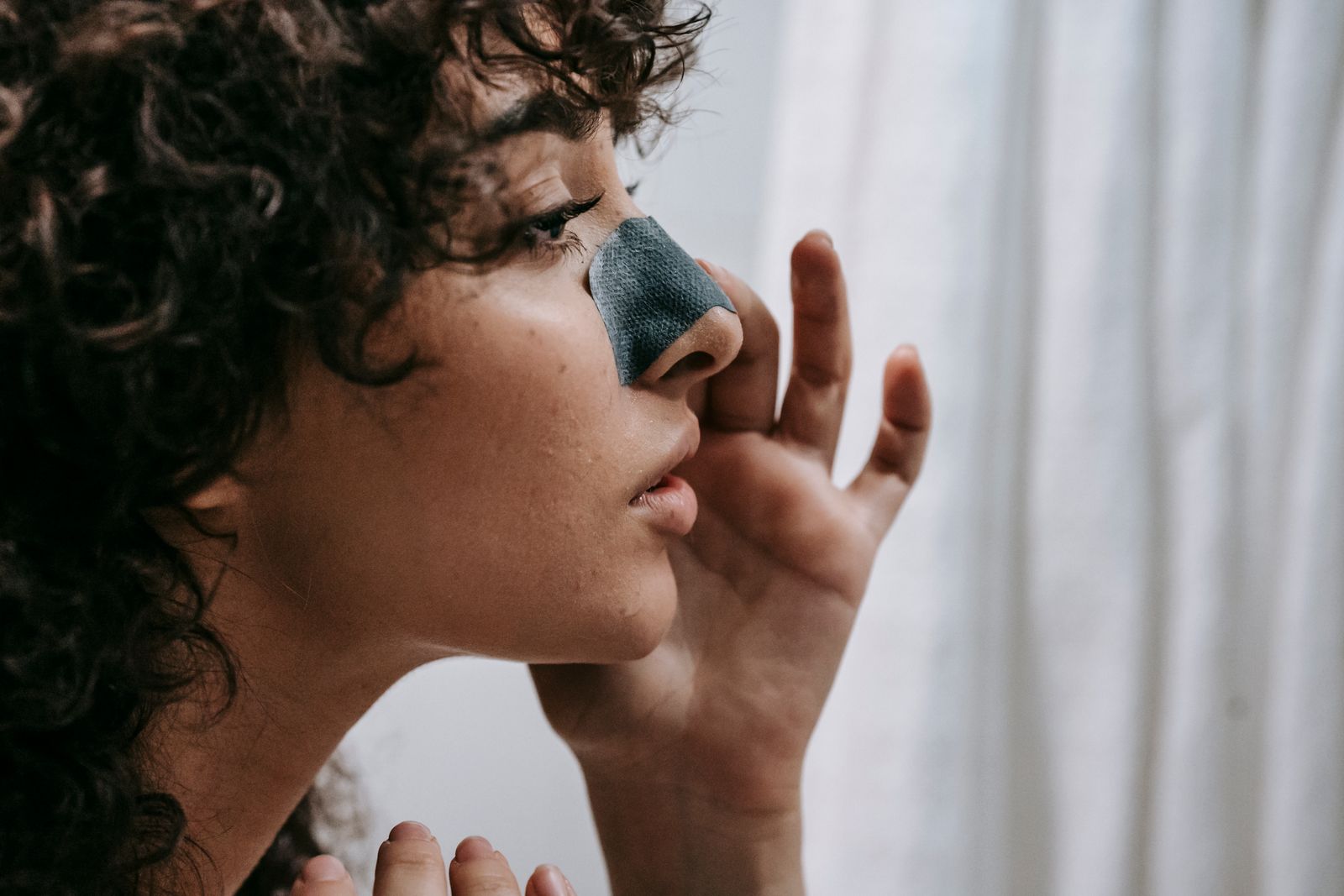
Here is the thing almost nobody tells you: most of the dark dots on your nose are not blackheads. They are sebaceous filaments — normal, hair-like structures made of sebum and dead cells that line the inside of every oil-producing pore. Everyone has them. They cannot be permanently removed, because they are not a flaw; they are how a working pore transports oil to the surface. A true blackhead (an open comedo) is different: it is an actual plug, oxidized dark at the top, that sits raised enough to catch a fingernail and can be extracted.
That distinction changes everything about what you should do. Chasing sebaceous filaments with squeezing, pore strips, and aggressive tools is a treadmill — they refill within days to a few weeks, and the squeezing itself stretches the pore wall so the next filling looks bigger and darker. Chasing true blackheads, on the other hand, does respond to a real plan. Below is how to tell which you have, why the squeezing reflex backfires mechanically, what an in-clinic session actually involves in Seoul, and what maintaining a smoother-looking nose costs over a year.
Sebaceous filaments vs. blackheads: how to actually tell them apart

Look closely, in daylight, at the skin rather than at a magnifying mirror (a 10x mirror makes normal anatomy look like a crisis).
Sebaceous filaments are typically:
- Uniform. Dozens of them, evenly spaced across the nose tip, alar creases, and sometimes the inner cheeks and chin — a repeating pattern, not scattered.
- Grey, tan, or light brown rather than black.
- Flat. Run a clean fingertip over them and the surface feels mostly smooth.
- Located where oil glands are densest — which is exactly why the nose is the classic site.
- When expressed, they come out as a soft, thin, pale filament that looks like a tiny worm of oil. It refills.
True blackheads (open comedones) are typically:
- Scattered and irregular. A handful, not a uniform field.
- Genuinely dark or black at the surface, from oxidized keratin and lipid.
- Slightly raised, with a palpable texture, and often a wider visible opening.
- Frequently accompanied by closed comedones (small skin-coloured bumps), whiteheads, or inflamed spots elsewhere — because they are part of the acne spectrum.
- When extracted, a firmer plug comes out, and that specific pore stays clearer for a while.
A useful mental test: if your nose looks the same as it did five years ago, and the dots are evenly distributed, you are looking at normal pore anatomy. If the dots appeared or worsened, are patchy, and travel with other breakouts, you are looking at comedonal acne — which is a treatable condition rather than an unchangeable feature.
One more variable people miss: pore size and oil output are largely genetic and hormonal. Larger sebaceous glands produce more sebum, fill filaments faster, and make the openings visually obvious. That is why two people using identical routines get different noses. It is also why an honest goal is “less noticeable,” not “gone.”
Why squeezing backfires — the actual mechanism

The relief of squeezing is real. So is the cost, and it is mechanical rather than moral.
1. You stretch the pore wall. A pore opening is elastic tissue with limited recoil, and that recoil declines with age and sun damage. Pinching the surrounding skin to force contents out applies outward pressure to that ring. Repeated often enough, the opening settles wider than it started — so the next time the filament fills, it presents as a larger, darker dot. You have not removed the problem; you have upgraded the frame it sits in.
2. You can rupture the follicle inward. If pressure does not clear the contents upward, the contents can be pushed sideways or down through the follicle wall into surrounding skin. Your immune system treats that displaced material as debris and mounts an inflammatory response. That is the origin of the tender red bump that shows up a day or two after a bathroom-mirror session where “nothing came out.”
3. Inflammation buys you pigment or a scar. Once a lesion becomes inflamed, you are on the hook for what follows — a red mark (post-inflammatory erythema) or a brown mark (post-inflammatory hyperpigmentation), and in unlucky cases a small depressed scar. Marks that take months to fade are a poor trade for a dot that was going to refill anyway. If you are already dealing with the aftermath, our guide to telling red marks from brown ones covers what actually fades each type.
4. Pore strips remove the top, not the plug. A strip pulls off the exposed, oxidized surface of filaments and some superficial keratin. The visual improvement is genuine and lasts roughly until the filament tip oxidizes again — often days. Meanwhile the adhesive is aggressive on the stratum corneum, and on already-irritated or barrier-compromised skin it can leave the nose red, flaky, and more reactive.
5. Metal comedone extractors are not safer in untrained hands. A loop extractor concentrates force into a small ring. Used at the wrong angle, on a lesion that is not ready, it produces the same wall rupture with more precision and more bruising.
The honest summary: squeezing a true blackhead that is genuinely ready to come out, with clean hands and gentle pressure, once, is survivable. Habitual squeezing of a nose full of sebaceous filaments reliably makes the nose look worse over a period of years.
What actually helps at home (and what to expect from it)
Before clinic options, the home layer does the majority of the maintenance work, because the underlying process is continuous.
Salicylic acid (BHA) is the most sensible first move. It is oil-soluble, so it penetrates into the sebum-filled pore rather than sitting on the surface. Used consistently — a few times a week for many people, daily for oily and tolerant skin — it keeps the pore lining shedding properly, which makes filaments less packed and less visible. It does not shrink pores.
Topical retinoids are the strongest evidence-based tool for genuine comedones, because they normalize how the follicle lining sheds and prevent new plugs from forming. They take time — meaningful change usually over weeks to months, often with an adjustment period of dryness and flaking. If you are travelling to Seoul for a treatment, timing matters: see when to stop and restart retinol around a procedure so you do not arrive with an irritated barrier.
Niacinamide is worth including for its effect on the look of pores and on oil, though its results are modest and gradual.
Sunscreen, unglamorously, matters here. Ultraviolet exposure degrades the collagen supporting the pore opening, and pores with less structural support around them look and stay larger. It is also the single biggest determinant of whether a post-inflammatory mark fades in weeks or in months.
What does not work: hot water and steam do not “open” pores (pores have no muscle to open or close — heat softens contents and swells surrounding skin temporarily); DIY glue or charcoal peel-off masks strip the barrier for a very short-lived result; scrubbing harder increases irritation and oil rebound without touching what is inside the follicle.
Realistic expectation for a good home routine on sebaceous filaments: less packed, less visible, in soft light barely noticeable — but still present under close inspection. Anyone promising erasure is selling something.
What in-clinic options actually exist in Seoul
Seoul clinics are unusually well-equipped for this category, largely because oily-skin and pore concerns are a mainstream reason for local visits, not a niche one. A few things are worth knowing before you book.
Professional extraction. Performed after softening the skin, with proper hygiene, appropriate lighting and magnification, and controlled pressure — often paired with a preparatory step to loosen contents first. This is the direct fix for true blackheads. It is not a permanent fix for sebaceous filaments; it clears the field, and the field refills. Expect some redness for a few hours to a day, and occasionally small pinpoint marks that settle within days.
Chemical peels. Salicylic-based peels are the workhorse for oily, comedone-prone skin: they loosen the plug material and normalize shedding across the whole treated area rather than pore by pore. Typically done in a short series rather than as a one-off, with mild flaking for a few days afterwards for stronger formulations, and often none at all for gentle ones.
Hydro-based cleansing devices. Vacuum-and-solution systems that soften and lift superficial pore contents while delivering exfoliating solution. Comfortable, essentially zero downtime, immediately visible improvement — and, honestly, quite temporary on filaments. A reasonable choice before an event; a poor choice as your whole strategy.
Non-ablative and fractional lasers. These target the deeper issue — stimulating collagen around the pore so the opening is better supported, and in some cases influencing sebaceous gland activity. This is where actual, durable change in pore appearance comes from, as opposed to emptying pore contents. Downtime ranges from a day of redness for gentler settings to several days of redness and flaking for more aggressive fractional work. Results build over multiple sessions and over months, not overnight.
Microneedling, with or without radiofrequency. Also a collagen-remodelling approach, useful when enlarged pores sit alongside shallow textural irregularity or acne scarring. Redness for one to three days is typical.
Prescription approaches for underlying oil production. When high sebum output is the real driver and topicals have not been enough, oral treatment may come into the conversation. This is a genuinely medical decision with real considerations — it belongs in a consultation, not in a blog post.
One caveat, stated plainly: no in-clinic device permanently eliminates sebaceous filaments. Anything that appeared to would have to destroy the oil gland’s outlet, which is not a desirable outcome. What clinic work realistically buys you is a clearer, better-supported, less shadowed pore that refills more slowly and reads as smoother.
Who is a poor candidate — and when to wait
Not everyone should be treated on the day they walk in.
- Currently inflamed, pustular, or cystic acne. Extraction and many peels are the wrong move on an actively inflamed face; the priority is calming inflammation first, and squeezing inflamed lesions is exactly how scars happen.
- A compromised barrier. Stinging, flaking, tightness, or reactive redness means the skin needs repair before any exfoliating or resurfacing step. Adding a peel to an already-angry barrier reliably makes things worse.
- Recent isotretinoin use. Standard practice is to wait a defined interval after finishing oral isotretinoin before resurfacing procedures, because healing behaves differently. Disclose it — it changes the plan.
- Active infection in the area, including cold sores anywhere near the treatment field.
- Recent significant sun exposure or a fresh tan, particularly before laser work, because of the pigmentation risk. This matters more if you are visiting Seoul mid-holiday.
- Deeper skin tones, which are not a contraindication but do require conservative settings and pigment-aware device selection. A clinic that adjusts its parameters is doing its job; one that runs the same settings on everyone is not.
- Pregnancy or breastfeeding, which rules out several topicals and some procedures.
- Realistic expectations. If the goal is “poreless,” treatment will disappoint regardless of technology. If the goal is “meaningfully less obvious and easier to maintain,” it usually delivers.
Individual anatomy, oil output, sensitivity and history vary enormously here, and outcomes vary with them. Any responsible plan starts with an assessment of your actual skin rather than a package chosen from a menu.
What it costs in Seoul, and what maintenance looks like
Costs vary widely across Seoul by clinic, device generation, treated area, and session length, and the number of sessions you personally need is not knowable before an assessment. What follows are approximate market ranges to help you budget, not quotes — and not MIO-specific prices.
Approximate Seoul ranges, per session:
| Approach | Typical range (KRW) | Approx. (USD) |
|---|---|---|
| Extraction / basic care facial | 50,000–150,000 | ~$36–110 |
| Salicylic or similar chemical peel | 50,000–200,000 | ~$36–145 |
| Hydro-based pore cleansing | 80,000–200,000 | ~$58–145 |
| Non-ablative / fractional laser for pores | 150,000–500,000 | ~$110–360 |
| Microneedling ± radiofrequency | 200,000–600,000 | ~$145–435 |
USD equivalents are rounded at an approximate exchange rate and will move; treat them as a rough sense of scale rather than a conversion you can hold anyone to. Packages of multiple sessions typically price lower per session than single visits, and the final figure depends on what your skin actually needs — which is why no honest clinic quotes it before seeing you.
A realistic annual pattern for someone maintaining an oily, filament-prominent nose: a device or peel series concentrated over a few months to get the initial change, then maintenance every one to three months, with home care doing the daily work in between. Skip the home layer and the maintenance interval shortens; keep it and the interval stretches. If you want a fuller picture of budgeting an oil-control program over time, we’ve broken that down in detail.
If you are visiting Seoul on a short trip, plan around downtime rather than volume. Extraction, a gentle peel, or a hydro-based cleanse fit comfortably into a trip with photos in it. Fractional laser work does not — book that at the end of the trip, or accept several days looking flushed and flaky. And do not schedule your first-ever aggressive resurfacing session two days before a wedding.
The honest bottom line
If your nose has evenly distributed grey dots that come back within a week of every extraction, you have sebaceous filaments, and the goal is management: a consistent BHA or retinoid routine, sunscreen, occasional professional cleaning, and letting go of the idea that they will disappear. If you have scattered dark, raised plugs alongside other breakouts, you have comedonal acne, and it genuinely responds to treatment.
Either way, the single highest-value change most people can make costs nothing: stop squeezing. The nose that gets left alone, treated consistently, and cleaned professionally a few times a year almost always looks better in two years than the nose that gets attacked in the mirror every Sunday night.
Book at MIO Clinic, Gangnam
Seoul Skin Notes is the official journal of MIO Clinic, a skin & aesthetic clinic in Gangnam, Seoul. The MIO team handles consultations and bookings in English over WhatsApp — tell them what you are considering and they will walk you through your options.
MIO Clinic
2-3F, FINE TOWER, 372 Gangnam-daero, Gangnam-gu, Seoul
Gangnam Station, Exit 4 — 3-minute walk
Hours: Mon & Fri 10:00–21:00 · Tue–Thu & Sat 10:00–19:00 · Sun closed
Web:mioclinic.kr/en · Instagram:@mioclinic_global · Email:en-official@mioclinic.kr · Google Maps