A scalp problem and a hair loss problem are not the same thing, and the first job of a scalp check in Seoul is to tell them apart. A scalp condition — flaking, itch, redness, oiliness, tenderness, buildup — affects the skin. Hair loss affects the follicle: the hairs get finer, shorter, and fewer in a pattern. The two often show up together, which is why people assume treating one fixes the other. It usually doesn’t. A first scalp visit typically involves a history, a look at your scalp and hairline under magnification, sometimes a pull test, and a plan that separates “your scalp is inflamed” from “your hair density is changing” — because those two findings lead to completely different treatments, timelines, and costs.
If you’re visiting Seoul and considering adding a scalp program to your trip, this is what that appointment actually looks like, what the in-clinic treatments can and can’t do, and where the honest limits are.
Scalp condition vs. hair loss: how to tell which one you have

They present differently, and the distinction changes everything about what you should spend money on.
Signs pointing to a scalp (skin) condition:
- Flaking, scaling, or crusting you can see or feel
- Itch, burning, tenderness, or a scalp that feels tight
- Visible redness, especially along the hairline, part, or behind the ears
- Greasiness that returns within hours of washing
- Small bumps, pustules, or sore spots
- Symptoms that fluctuate week to week with stress, weather, or products
Signs pointing to hair loss (follicle change):
- Widening part line, or a ponytail that feels thinner in your hand
- Hairs that are noticeably finer and shorter than your other hairs (miniaturization)
- A receding or thinning temple/frontal hairline
- Scalp showing through in a specific pattern rather than everywhere
- Shedding that increased noticeably 2–4 months after an illness, crash diet, childbirth, major stressor, or medication change
- Gradual change over years rather than flare-and-settle cycles
Why they get confused: an inflamed, itchy scalp makes you scratch and rub, which breaks hairs and increases shedding — so it looks like hair loss. And genuine pattern hair loss makes the scalp more visible, so you start noticing flaking that was always there. People often arrive convinced they have one when the exam shows the other, or both.
The practical implication: if you spend a whole trip on soothing scalp facials and your actual issue is pattern hair loss, you’ll feel better and see no change in density. If you start hair-loss treatment on a scalp that’s actively inflamed, the irritation can make topical products intolerable. Sequencing matters, and that’s the point of getting it looked at properly first.
What a first scalp check actually covers

Expect a consultation-style appointment rather than a treatment. In broad terms, it involves:
History. How long it’s been changing, whether it’s shedding or thinning (different questions), family history on both sides, recent illness or fever, weight change, new medications, thyroid or iron issues, pregnancy or postpartum status, how you wear and style your hair, and what you’ve already tried. This is genuinely the highest-yield part — a lot of scalp and hair problems are diagnosed in the history, not the exam.
Visual exam of the scalp and hairline. Looking at the pattern: frontal hairline, temples, the part line, the crown, the nape. Pattern is diagnostic. Diffuse thinning everywhere reads differently than a receding temple or a widening part.
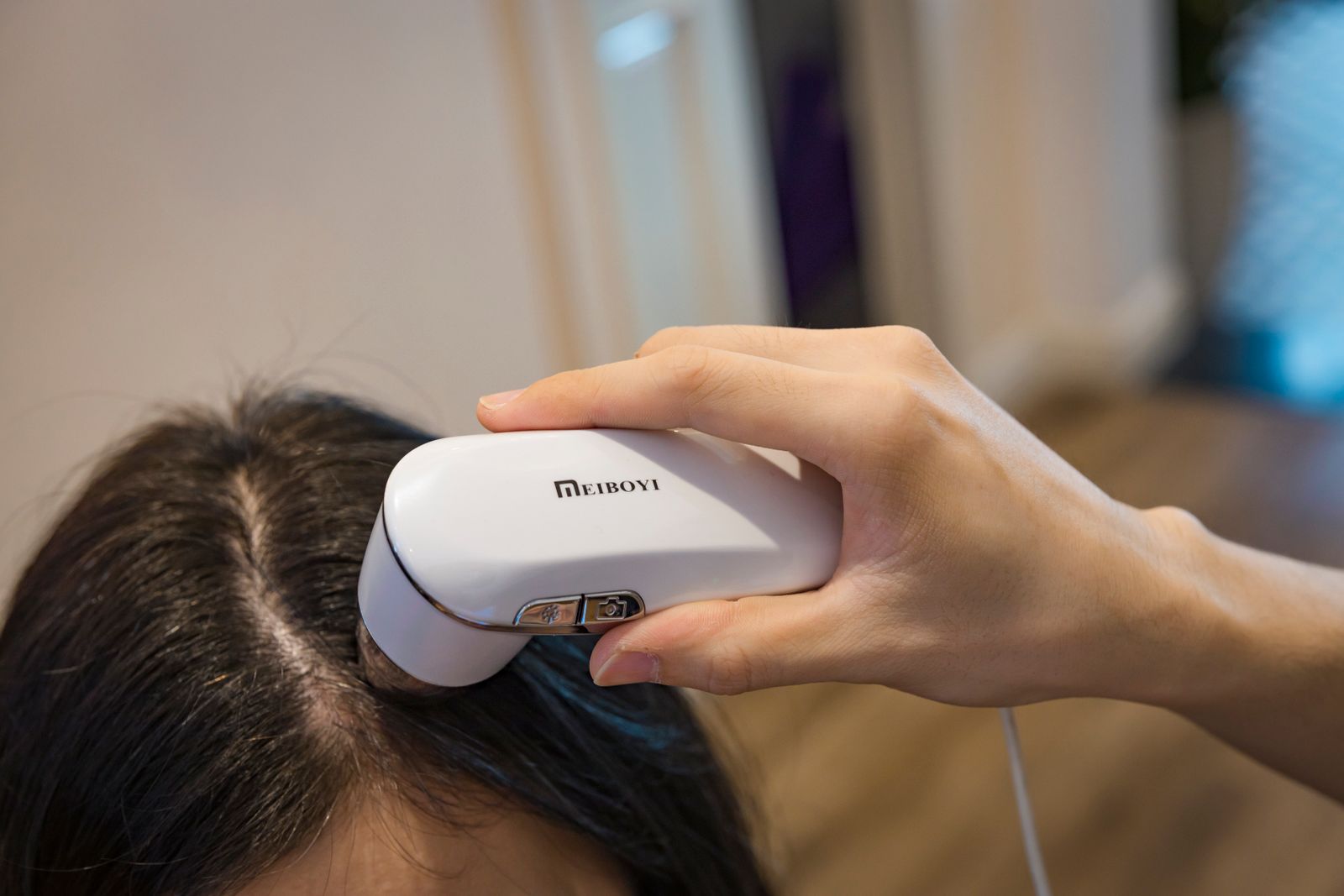
Magnified scalp imaging. Most clinics use a magnifying scalp camera to look at follicle openings, how many hairs are emerging per follicular unit, hair shaft thickness variation, oiliness, scaling, redness, and any scarring. Images are usually saved so you have a baseline to compare against later — which is the only way to judge progress honestly, since nobody can remember what their part line looked like four months ago.
Simple in-office tests. A gentle pull test (how many hairs release with light traction) helps gauge active shedding. Some clinics do a wash test or ask you to count shed hairs at home for a few days.
Bloodwork, when the history suggests it. Iron/ferritin, thyroid, vitamin D, and hormonal panels are commonly checked when the picture suggests something systemic — especially with sudden diffuse shedding in women. If you’re in Seoul briefly, ask upfront whether results come back within your trip.
A plan with a stated timeline. You should leave knowing which category you’re in, what’s proposed, roughly how long before you’d expect to judge it, and what the maintenance looks like.
This is also just a normal first-visit clinic flow — if you’ve never been to a Korean clinic before, what actually happens at a first Seoul skin clinic visit covers the consultation, payment, and language side in more detail.
What a scalp check can’t tell you
This is the part that gets skipped in most clinic content, and it’s the part that protects you from disappointment.
- A camera can’t diagnose everything. Scalp imaging shows current state — density, shaft thickness, inflammation. It doesn’t tell you the cause on its own. Two people with identical images can have different underlying reasons.
- It can’t predict how much hair you’ll keep. Nobody can tell you where your hairline will be in ten years. Anyone who does is guessing.
- A single visit can’t reliably separate temporary shedding from early pattern loss. Telogen effluvium — the diffuse shedding that follows illness, stress, or a nutritional hit — often resolves on its own over months. Early pattern loss doesn’t. Sometimes the honest answer is “let’s image you now and re-image in 3–6 months,” which is unsatisfying but accurate.
- It can’t reverse scarring. Where follicles have already been permanently lost — in scarring types of hair loss, or long-standing advanced pattern loss — no topical, injection, or device brings them back. Treatment in that situation is about protecting what remains. A good clinic will say this plainly rather than sell you a course.
- A short trip limits what can be confirmed. If bloodwork or a scalp biopsy is indicated, that may not fit a five-day itinerary.
What in-clinic scalp programs actually involve
“Scalp program” in Seoul usually means a package of several session types. Here’s what the common components realistically do.
Scalp scaling / deep cleansing. Softening and removing buildup — sebum, product residue, flakes — usually with a solution, gentle manual or device-assisted lifting, and a wash. This genuinely helps a congested, oily, or flaky scalp feel and look better. It does not increase hair density. Think of it as a reset for the skin, not a hair treatment. Effects are temporary and it’s typically repeated.
Soothing and barrier care. Cooling masks, calming solutions, and LED sessions aimed at redness and irritation. Comfortable, low-risk, and reasonable when your main complaint is itch and sensitivity — with the same caveat that comfort improvement isn’t density improvement.
Scalp injection sessions (mesotherapy-style). Small, superficial injections of a solution across the scalp, usually in a course of several sessions spaced weeks apart. Formulations vary widely between clinics and countries, which is precisely why the evidence is inconsistent — you’re not comparing one standardized thing. Sensation ranges from mild pinching to genuinely uncomfortable, depending on your pain tolerance and the area. Expect small pinpoint marks and tenderness for a day or so.
Microneedling-based scalp treatments. Controlled micro-injury to the scalp, sometimes combined with topicals. There’s a reasonable rationale here, and it’s often used alongside — not instead of — medical treatment. Redness and tenderness for a day or two is normal.
Blood-derived injectable treatments. Your own blood is drawn, processed, and re-injected into the scalp. Evidence quality is mixed and preparation methods differ between clinics, so results reported in studies aren’t necessarily transferable. It tends to be one of the more expensive options, and it’s maintenance-dependent — improvement fades without repeat sessions. Worth asking directly how many sessions are proposed and what happens if you stop.
Low-level light / laser devices. In-clinic sessions or take-home caps. Generally low-risk and painless; effect sizes reported in the literature are modest and it requires consistent long-term use.
Medical treatment for pattern hair loss. This is the part people underestimate. For androgenetic (pattern) hair loss, the treatments with the strongest and longest track record are prescription and over-the-counter medications — topical and oral — not in-clinic sessions. They require a doctor’s assessment, carry real side effect considerations, and some are strictly contraindicated in pregnancy or for women who may become pregnant. They also only work while you take them. Any honest scalp plan for pattern loss will address whether medication is appropriate for you, rather than routing everything to session packages. If a plan for clear pattern loss consists only of in-clinic sessions, ask why.
If you’re stacking a scalp program with facial treatments in the same trip, the sequencing rules in how many treatments you can safely combine in one Seoul visit apply here too — injections and microneedling on the scalp are still procedures with a recovery window.
Hairline care specifically
The hairline gets its own attention because it fails in ways the rest of the scalp doesn’t.
Traction thinning. Tight ponytails, buns, braids, extensions, and clips pulling at the same spots for years thin the frontal and temple hairline mechanically. This is one of the few hair problems where the fix is largely behavioral — loosening tension, rotating styles, avoiding tight styling on damp hair. Caught early it often recovers. Left long enough it becomes permanent, because the follicle scars.
Frontal recession. In pattern loss, the temples and frontal line often go first in men and can show as a widening front-of-part in women. This is where imaging baselines matter most, because progression is slow and comparison by memory is unreliable.
Irritation along the hairline. Redness and flaking right at the hairline is extremely common and frequently product-related — heavy stylers, sunscreen residue, dry shampoo buildup, or a cleanser that doesn’t get rinsed out of that zone. It’s often the easiest thing on this whole list to fix.
Cosmetic and procedural options. Beyond medical treatment, options like scalp micropigmentation (tattooing to reduce contrast between scalp and hair) and surgical transplantation exist. Transplantation is surgery, done at specialized surgical clinics, with its own consultation process, recovery, and cost structure entirely separate from the scalp programs described here. It’s worth knowing the boundary: a skin clinic scalp program and a hair transplant are different services.
Sun exposure. A thinning part line or hairline is exposed scalp, and it burns. If your part is widening, it needs sun protection like any other skin — a hat, or a sunscreen you’ll actually apply there.
Downtime, sensation, and risks — honestly
Non-injection sessions (scaling, soothing, LED) generally have no downtime. Your hair will be damp when you leave. Some solutions have a smell that lingers until your next wash.
Injection and microneedling sessions: expect tenderness, mild swelling, small pinpoint scabs, and a scalp that’s sore to brush or sleep on for a day or two. Most people go straight back to normal activity. Wash-timing instructions vary by clinic — ask, don’t assume.
Risks worth knowing about:
- Infection at injection sites (uncommon, but the reason aftercare instructions exist)
- Persistent irritation or an allergic/contact reaction to a solution or topical
- Temporary increased shedding when starting some treatments — this is well-described and unnerving if nobody warns you
- Bruising, especially along the hairline and temples
- Headache or scalp tenderness for a day
- Wasted money and time on a program aimed at the wrong problem — the most common bad outcome by far
If your scalp is already reactive, say so before anything is applied to it. The same logic that applies to facial treatments applies here — how a clinic should adjust the plan for sensitive skin is worth reading before your consultation.
When a scalp program isn’t the right call
Be wary of committing to a package if:
- You have active inflammation, sores, or infection. That gets treated first. Injecting into an inflamed scalp isn’t the move.
- Your shedding started abruptly 2–4 months after a clear trigger. That pattern often resolves on its own. Give it time and investigate causes before buying sessions.
- You haven’t had bloodwork and your history suggests a systemic cause — heavy periods, restrictive dieting, recent surgery, postpartum, thyroid symptoms. Fix the cause and the hair often follows.
- You’re pregnant or breastfeeding. Many treatments and nearly all hair-loss medications are off the table. A clinic should ask; tell them regardless.
- You have a scarring type of hair loss. The goal shifts to halting progression, and the treatment path is different.
- You’re on a three-day trip. Almost nothing here produces visible change in three days. A consultation and imaging baseline is a genuinely useful use of that time. A single session of anything is not.
- Your expectation is restoring a hairline to where it was ten years ago. Non-surgical treatment maintains and can partially improve; it doesn’t rewind.
Realistic timelines
Hair moves slowly, and this is where most disappointment comes from.
- Scalp comfort (itch, flaking, oiliness): often improves within days to a couple of weeks.
- Reduced shedding: typically the first sign anything is working, around 2–3 months in.
- Visible density change: realistically 4–6 months minimum, and judged by comparison photos under consistent lighting — not by how your hair looked this morning.
- Full assessment of whether a treatment works for you: 6–12 months.
- Maintenance: for pattern hair loss, ongoing. Stopping generally means returning to your untreated trajectory over the following months. This is worth being clear-eyed about before you start, especially if you’re starting something in Seoul that you’ll need to continue at home.
Individual response varies substantially, and some people don’t respond to a given treatment at all.
What it costs (approximate Seoul ranges)
There’s no meaningful “scalp program price” because programs bundle different components. These are broad Seoul market ranges, not any one clinic’s pricing, and they change — treat them as orientation only. Conversions use roughly ₩1,380 to the US dollar at the time of writing.
| Item | Approximate Seoul range |
|---|---|
| Consultation with scalp imaging | ₩0–50,000 (about $0–36) — often waived or credited if you proceed |
| Scalp scaling / deep cleanse session | ₩50,000–150,000 (about $36–109) |
| LED / low-level light session | ₩30,000–100,000 (about $22–72) |
| Scalp injection session (mesotherapy-style) | ₩100,000–300,000 (about $72–217) per session |
| Microneedling-based scalp session | ₩150,000–400,000 (about $109–290) per session |
| Blood-derived injectable session | ₩200,000–500,000 (about $145–362) per session |
| Prescription/OTC hair medication | roughly ₩20,000–80,000 (about $15–58) per month, ongoing |
| Bloodwork panel | ₩50,000–200,000 (about $36–145) depending on scope |
Two things skew the real total. First, injection-based treatments are almost always sold as courses of 4–10 sessions, so the per-session number is not the number that matters — ask for the course total before you agree to anything. Second, if pattern hair loss is the diagnosis, the recurring monthly medication cost over years will likely exceed whatever you spend on in-clinic sessions during your trip.
At MIO Clinic, the approach is assessment-first and deliberately conservative — AI-assisted analysis and an exam before anything is proposed, and a preference for treating the actual finding rather than defaulting to the largest package. Final cost depends entirely on what the assessment shows, so it can’t be quoted before you’re seen.
How to make a Seoul scalp visit worth it
A few things that materially improve what you get out of the appointment:
- Bring photos of your hairline and part from 1, 3, and 5 years ago. Rate of change is diagnostic and you’re the only person who has that data.
- Don’t wash your hair the morning of the visit unless told otherwise — a scalp that’s been stripped clean an hour earlier shows less.
- Bring a list of everything you’re taking, including supplements and anything you’ve stopped in the last year.
- Ask for your baseline images to be saved and, if possible, sent to you. Without a baseline you can’t judge results later.
- Ask specifically: “Is this a scalp problem, a hair problem, or both?” If you can’t get a clear answer to that, you’re not ready to buy a package.
- Ask what happens after you fly home — what’s continuable, what needs a local prescription, and what you’d need to come back for.
The most valuable outcome of a first scalp visit often isn’t a treatment at all. It’s knowing which of the two problems you actually have, having a dated baseline to measure against, and not spending your trip budget on the wrong category.
FAQ
Can a scalp treatment regrow hair I’ve already lost? Where the follicle is still alive but miniaturizing, treatment can improve thickness and density over months. Where follicles have been lost to scarring or long-standing advanced pattern loss, no non-surgical treatment brings them back — the realistic goal there is preserving what remains. A magnified exam is how that distinction gets made.
Is one scalp session during a short Seoul trip worth it? For comfort issues like flaking, itch, or oiliness, a single cleansing or soothing session can feel good — but the effect is temporary. For thinning, a single session of anything will not produce visible change. If your trip is short, the highest-value use of the time is a consultation with scalp imaging so you leave with a diagnosis and a dated baseline.
Do scalp injections hurt? Most people describe it as pinching or stinging rather than sharp pain, with the hairline and temples usually more sensitive than the crown. Numbing options vary by clinic. Expect scalp tenderness for a day or two afterward, and possibly small pinpoint marks or minor bruising.
Why did my shedding get worse after starting treatment? A temporary increase in shedding after starting certain hair treatments is a recognized, generally short-lived phase as follicles cycle. It’s alarming if nobody warns you about it. It should settle over a few weeks — if it doesn’t, or if it’s dramatic, go back and be reassessed rather than quietly stopping.
Do I need to keep treatment going after I go home? For pattern hair loss, yes — these treatments maintain rather than cure, and stopping generally means returning to your previous trajectory over the following months. Before starting anything in Seoul, ask what’s continuable at home, what needs a local prescription, and what the ongoing monthly cost looks like.
What’s the difference between a scalp program at a skin clinic and a hair transplant? They’re different services. Scalp programs at a skin clinic address scalp health and work on follicles that are still present — non-surgical, session-based, maintenance-dependent. A transplant is surgery that relocates follicles, performed at specialized surgical clinics, with its own consultation, recovery period, and cost structure. Many people with advanced loss end up discussing both.
Book at MIO Clinic, Gangnam
Seoul Skin Notes is the official journal of MIO Clinic, a skin & aesthetic clinic in Gangnam, Seoul. The MIO team handles consultations and bookings in English over WhatsApp — tell them what you are considering and they will walk you through your options.
MIO Clinic
2-3F, FINE TOWER, 372 Gangnam-daero, Gangnam-gu, Seoul
Gangnam Station, Exit 4 — 3-minute walk
Hours: Mon & Fri 10:00–21:00 · Tue–Thu & Sat 10:00–19:00 · Sun closed
Web:mioclinic.kr/en · Instagram:@mioclinic_global · Email:en-official@mioclinic.kr · Google Maps