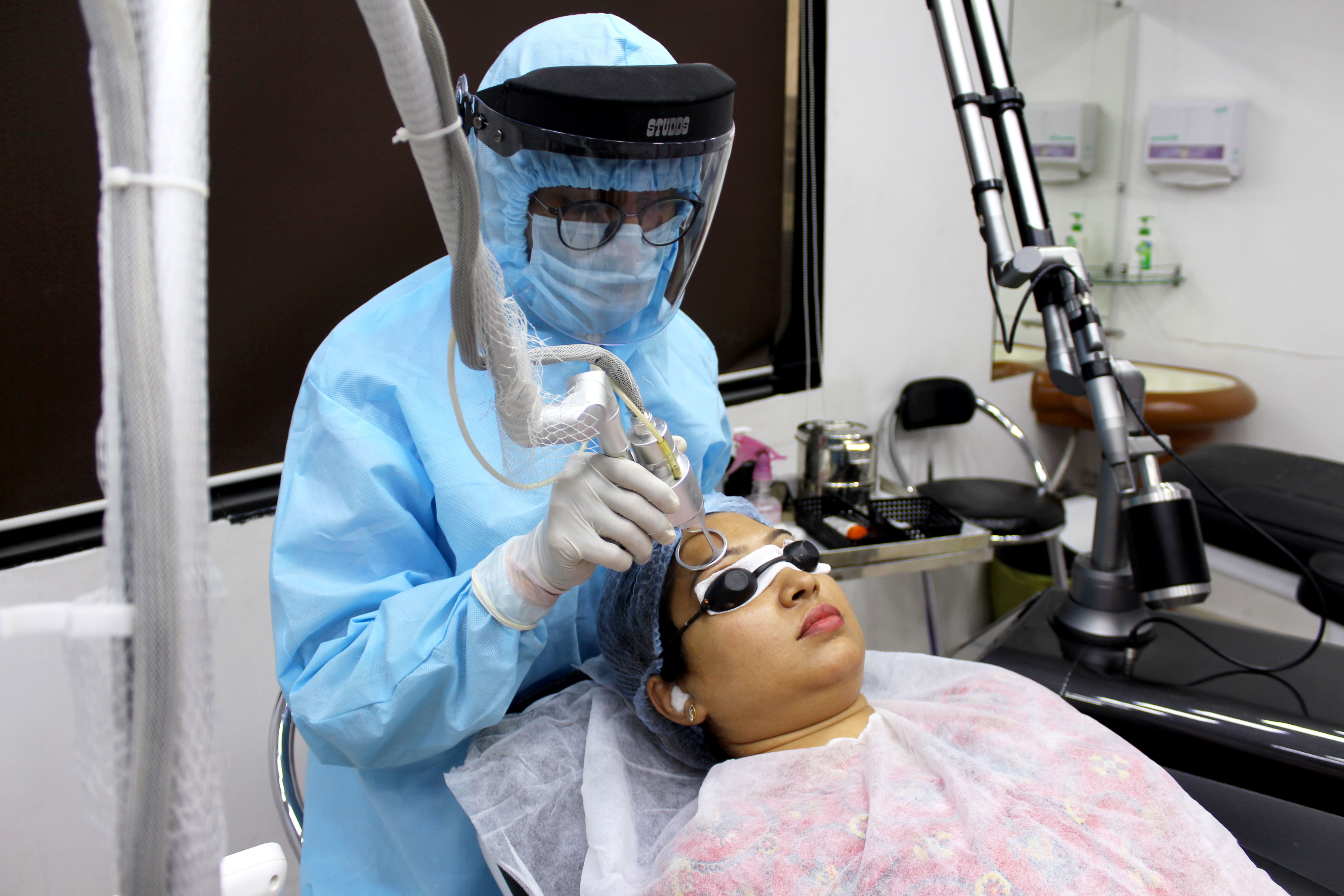
If you’ve spent years looking past the acne itself and at what it left behind, you already know that scars are a different problem from breakouts. The redness fades, the pimples stop, and yet the surface of your skin still holds the story in little dents, shadows, and uneven texture that makeup never quite covers. You may have tried a single laser package back home, seen a modest improvement, and quietly wondered whether anything actually moves the needle on deeper scarring. That question is exactly why so many English-speaking visitors start researching acne scar treatment in Seoul, where the standard approach tends to be layered rather than singular.
This guide walks you through three of the workhorse techniques used for atrophic acne scars — subcision, fractional CO2 laser, and TCA CROSS — and why Korean clinics, including MIO Clinic in Gangnam, often combine them instead of relying on one. None of this is medical advice, and results vary from person to person depending on scar type, skin tone, and healing. Think of it as a map for the conversation you’ll eventually have with a clinic, not a prescription.
Why deep acne scars rarely respond to one treatment

Atrophic acne scars — the depressed kind — are not all the same, and that’s the core reason a single device tends to disappoint. Clinicians usually sort them into three rough shapes. Rolling scars are broad, gently sloping depressions that give the skin a wavy look under angled light. Boxcar scars have sharper, more defined edges, like shallow craters. Ice pick scars are narrow and deep, almost like a tiny puncture that reaches well into the skin. Most people who’ve had moderate to severe acne carry a mix of all three on the same face.
A treatment that works beautifully on one type can barely touch another. Resurfacing lasers smooth shallow, broad texture but struggle with the tethering deep under a rolling scar. A technique built for the narrow channel of an ice pick scar does nothing for a wide rolling depression. When you treat a mixed face with only one tool, you’re essentially asking that tool to do jobs it was never designed for, then judging the whole result by its weakest performance. That’s how people end up concluding that “nothing works,” when really the plan was incomplete.
The Korean approach tends to flip the logic. Instead of one device repeated over and over, the goal is to match each scar type to the technique that addresses it, then run those techniques in deliberate combination across a series of sessions. It’s slower to explain and a little more involved to plan, but it respects the fact that your face isn’t carrying one problem — it’s carrying several at once.
Subcision, CO2 laser, and TCA CROSS explained

Subcision targets the tethering you can’t see. Many rolling scars are pulled down by fibrous bands beneath the surface — little anchors of scar tissue connecting the skin to deeper layers. Subcision uses a fine needle or blunt cannula inserted under the scar to release those bands, freeing the skin to lift back toward the surface. The release also triggers a wound-healing response that can encourage new collagen in the freed pocket. Because it works on the structure underneath rather than the surface, subcision is often the foundation step for broad, anchored rolling scars that lasers alone leave behind. Expect some bruising afterward; it’s working below the skin, so the visible aftermath is more bruise than burn.
Fractional CO2 laser handles texture and the surface remodeling. Rather than treating the whole face as one sheet, a fractional laser delivers thousands of microscopic columns of energy, leaving healthy skin between them to speed healing. Those tiny zones of controlled injury prompt the skin to rebuild collagen, gradually smoothing boxcar edges and refining overall texture over the weeks that follow. CO2 is one of the more powerful resurfacing options, which means meaningful downtime — redness, a sandpapery feel, and a few days of looking visibly treated — but also strong remodeling for the right candidate. Skin tone matters here, so this is a step the clinic should assess carefully before recommending intensity.
TCA CROSS is the precision tool for ice pick scars. CROSS stands for chemical reconstruction of skin scars, and the technique involves applying a high-concentration trichloroacetic acid solution to the bottom of a narrow, deep scar with a fine applicator — only inside the scar, not the surrounding skin. The focused injury prompts collagen to build up within the pit, slowly raising the floor of the scar over multiple sessions. It’s tedious, point-by-point work that rewards a steady, experienced hand, and it’s typically done in a series spaced weeks apart. For the narrow scars that frustrate lasers, it’s often the most logical answer.
Why Seoul clinics combine instead of standalone

Once you see what each technique does, the combination logic almost designs itself. Subcision releases and lifts the anchored rolling scars from below. Fractional CO2 resurfaces the broad texture and softens boxcar edges on top. TCA CROSS rebuilds the narrow ice pick pits one by one. Used together across a planned series, they cover the full range of scar shapes a typical face carries — which is precisely what a standalone treatment can’t do.
This is where the difference between a single US package and the layered Seoul approach becomes concrete. It’s not that one device is secretly better; it’s that scar revision is a sequencing problem as much as a technology problem. The order matters, the spacing between sessions matters, and so does honest staging — some clinics will start with subcision on the deepest tethered areas, let things settle, then layer resurfacing and CROSS in later visits. Skin boosters such as Rejuran, which support healing and skin quality, sometimes round out a plan to help the overall texture recover between the heavier steps. Done well, the whole sequence is built around your specific mix of scars rather than a one-size template.
It’s also worth being honest about timelines and expectations. Deep scar revision is a marathon, not a single dramatic before-and-after. Collagen remodeling unfolds over months, and a realistic plan usually spans several sessions with healing time built in between. Anyone promising to erase years of scarring in one visit is overselling. The more useful promise is meaningful, gradual improvement — softer edges, shallower pits, smoother light across the skin — assessed honestly as you go.
What a careful first consultation looks like at MIO
If you’re flying in from the US, the consultation is the part that actually determines your results, more than any single device. A thoughtful first visit starts with reading your skin: mapping which scars are rolling, which are boxcar, which are ice pick, and factoring in your skin tone and how you tend to heal. At MIO Clinic in Gangnam, that assessment is supported by AI skin analysis, which adds data to the eye of the practitioner rather than relying on guesswork. From there, the point is to build a sequence — what to treat first, what to layer later, and how much downtime each step realistically costs you, which matters a lot when your time in Seoul is limited.
MIO’s general approach is deliberately low-pressure: recommend what genuinely suits the individual, skip what doesn’t, and keep pricing transparent rather than bundling you into more than you need. For scar work specifically, that restraint is a feature, not a limitation — a clinic willing to tell you a given step won’t help your particular scars is one worth trusting. Pricing on the clinic’s published menu starts from modest per-session figures for several relevant treatments, and the right combination depends entirely on what your skin actually needs, which the clinic can assess in person. The clinic is also newly opened, currently running a grand-opening period, so it’s a reasonable moment to ask what that means for a multi-session plan.
The takeaway is simpler than the science: deep acne scars respond to a plan, not a product. If you understand the roles of subcision, fractional CO2, and TCA CROSS — and you go in expecting a staged, honest series rather than a miracle in one sitting — you’ll have a far more productive conversation with whichever clinic you choose. Bring your questions, ask what each step is meant to do for your particular scars, and let the assessment guide the sequence from there.
Book at MIO Clinic, Gangnam
Seoul Skin Notes is the official journal of MIO Clinic, a skin & aesthetic clinic in Gangnam, Seoul. The MIO team handles consultations and bookings in English over WhatsApp — tell them what you are considering and they will walk you through your options.
MIO Clinic
2-3F, FINE TOWER, 372 Gangnam-daero, Gangnam-gu, Seoul
Gangnam Station, Exit 4 — 3-minute walk
Hours: Mon & Fri 10:00–21:00 · Tue–Thu & Sat 10:00–19:00 · Sun closed
Web:mioclinic.kr/en · Instagram:@mioclinic_global · Email:en-official@mioclinic.kr · Google Maps